April 2026
Hampstead, 1968: How a Quiet Mansion on West Heath Road Became Rock and Roll's Most Iconic Backdrop
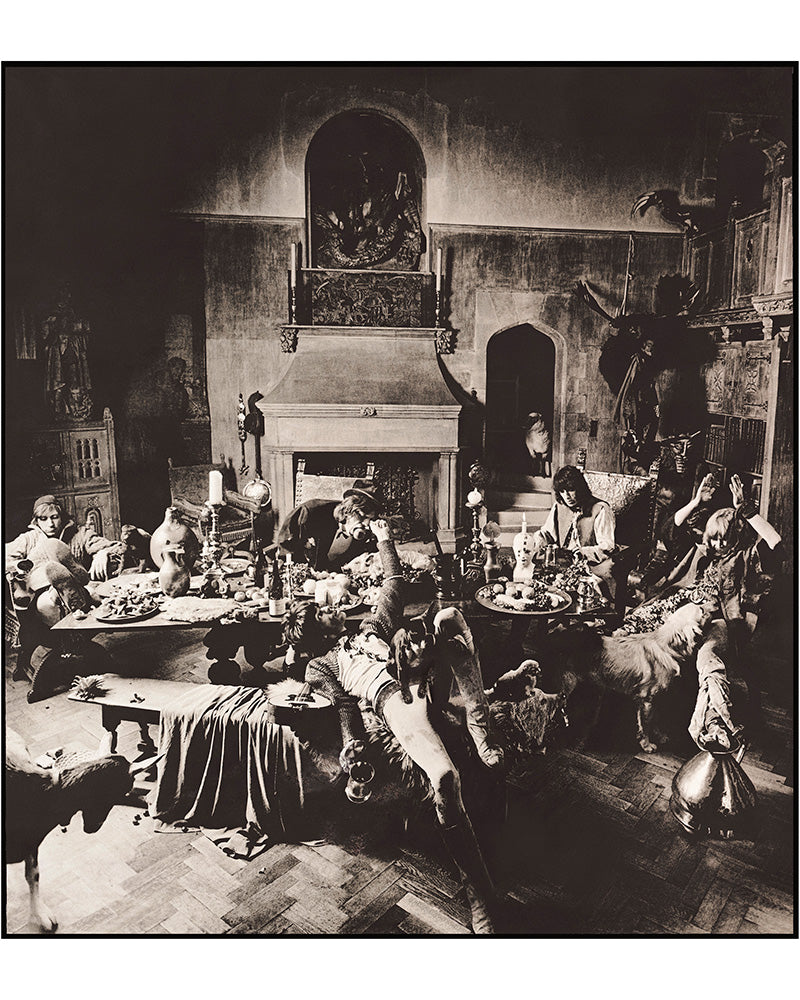
Walk from Zebra One Gallery up Heath Street, past Whitestone Pond, and turn left onto West Heath Road. Within ten minutes you arrive at the gates of Sarum Chase — a rambling 1930s neo-Tudor mansion built for the society portraitist Frank O. Salisbury. It is, by any measure, an unlikely shrine to rock and roll. And yet for two days in June 1968, this was the centre of the musical universe. The Rolling Stones had just finished recording 'Beggars Banquet'. Mick Jagger, Keith Richards, Brian Jones, Charlie Watts and Bill Wyman needed a cover image. The young South African-born photographer Michael Joseph — who had cut his teeth shooting British advertising in Soho — was given the commission. Joseph chose Sarum Chase for its faded grandeur: peeling oak panelling, a baronial dining room, mounted hunting trophies, and a wide green lawn that opened on to the Heath beyond. What unfolded over those two days has become one of the most reproduced sequences in rock photography. The band drinking at a long mahogany table. Mick and Keith sharing a glass. Brian Jones in a fur coat sprawled on the staircase. The five of them playing cricket in the back garden, Charlie Watts mid-bowl. A mock-jousting tournament with Keith brandishing a mandolin. And, most memorably, the so-called 'classic' line-up shot in front of the carved fireplace — the image that would, in countless reissues and retrospectives, come to stand for Beggars Banquet itself. The album cover that Joseph and the band wanted Decca to use was a separate matter entirely: a graffiti-covered lavatory wall in a Los Angeles workshop. The label refused. The album was released, after a five-month delay, with a plain ivory sleeve designed to look like a wedding invitation. Joseph's reportage from Hampstead was relegated to the inner gatefold, and then — for decades — to obscurity. It was only in the late 1980s, when the Stones reissued Beggars Banquet on CD with the original lavatory cover restored, that Joseph's photographs began to circulate in earnest. By the 2000s they had become collectors' items in their own right: limited-edition prints, hand-signed by Joseph, exhibited internationally. The Sarum Chase shoot is now widely understood as the lost original visual identity of one of the most important rock albums ever made. Hampstead, of course, has always been more than a leafy postcode. The Vale of Health drew Keats and D.H. Lawrence; Sigmund Freud spent his last year in a house on Maresfield Gardens; Anna Pavlova kept her swans on the lake at Ivy House. And in the 1960s and 1970s the area's elegant detachment from central London made it a magnet for the new wave of rock aristocracy. Robert Plant kept a flat in Belsize Park. George Michael's family lived on Hampstead Lane. Kate Bush attended St Joseph's Convent. Linda McCartney shot the Beatles around the Heath. The neighbourhood was, for a brief period, both genteel and gloriously unrespectable. Joseph's Sarum Chase series is the perfect distillation of that contradiction: dukes and duchesses dispossessed by men in scarves and beads, drinking from cut-glass decanters in a baronial hall a fifteen-minute walk from Zebra One Gallery's front door. The mansion itself was demolished in the 2010s; the photographs are now the only remaining record of what it looked like inside. Each print in the 'Beggars Banquet at Sarum Chase' series is hand-signed by Michael Joseph and produced as a strictly limited edition. Available in multiple sizes from Zebra One Gallery.
Zebra One Gallery