Sunday B. Morning
The Belgian silkscreens Warhol himself helped set in motion — printed from his original photo negatives and stamped "fill in your own signature".
The strangest, most important Warhol prints ever made.
The origin of the name Sunday B. Morning remains a mystery. It is rumoured to have derived from Sunday Belgian Morning, but who really knows? Much of the workshop's earliest history is lost.
What is known is that, after publishing his celebrated Factory Editions of Marilyn, Flowers and the Campbell's Soup Cans, in 1970 Andy Warhol began collaborating with two anonymous friends in Belgium on a second series of prints. The original idea was to play on the concept of mass production — a phenomenon Warhol returned to obsessively. The verso stamp "fill in your own signature" was his joke about the collapse of authorship: "here we just mass-produced these prints; sign your name. Any name will do. Yours is as important as my own." The new prints were exact in detail to the Factory editions, and Warhol was, in effect, mocking the idea that the Factory editions were somehow more important than these.
At some point talks broke down. Maybe Warhol had second thoughts about how the Belgian project might affect the market for his Factory editions. By that time he had already handed over the photo negatives and the colour codes used to produce the prints, and the Belgians had taken them to begin printing.
And print they did. They published editions of 250 each of Marilyn, Flowers, Campbell's Soup Cans and Campbell's Soup Cans II — produced with exactly the same tools and methods Warhol himself had used. These early black-ink editions are now noted in Feldman & Schellmann's Andy Warhol Prints: A Catalogue Raisonné 1962–1987. Page 173 reads: "This is an unauthorised print 36 x 36 in. (91.4 cm) in an edition of 250 with a stamped number. Stamped in black ink on verso 'fill in your own signature' and published by Sunday B. Morning."
Warhol was unhappy with the project, but unable to stop it: he had already supplied the means. So whenever he ran across a Sunday B. Morning print, he would sign it "this is not by me — Andy Warhol". This of course only made the prints more sought-after, especially the ones he signed in defiance.
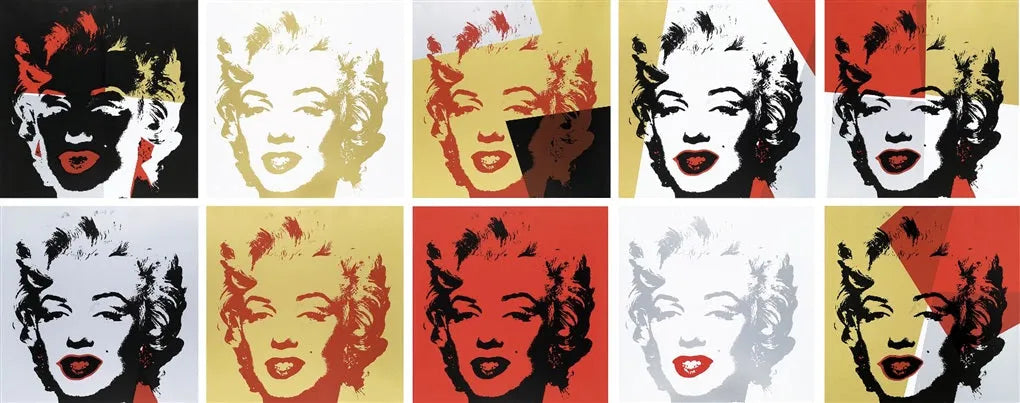
Today, the original 1970 black-ink Sunday B. Mornings are very rare; many did not survive. In the late 1990s the workshop began publishing again — now stamping the verso in blue ink — and continues to publish the Marilyns, Flowers, Soup Cans and Maos alongside a programme of newer limited editions: Golden Marilyn, Diamond Dust Marilyn, Dollar Signs, the Scream after Munch, the Mona Lisa after Leonardo, Moonwalk and Beethoven. Ownership of the workshop has changed hands a couple of times, but the prints are still made by the same Belgian print shop, using the same processes, with the same tools Warhol himself originally supplied. No other publisher comes close.
Verso Stamps
Each print stamped "published by Sunday B. Morning" and "fill in your own signature".
Catalogue Raisonné
Recognised in Feldman & Schellmann's Andy Warhol Prints, 1962–1987, p. 173.
Belgian Printshop
All editions printed at the original 1970 workshop in Belgium, on museum board, using Warhol's photo negatives.
Marilyn
Flowers
Campbell's Soup Cans — Series I (1968)
Mao
Golden Marilyn
I Love Your Kiss Forever Forever
Dollar Signs
Campbell's Soup Cans — Series II (1969)
The Scream (after Edvard Munch)
In the spirit of 1970.
At Zebra One we offer a bespoke framing service inspired by the way the original 1970 Sunday B. Morning editions were presented: encased in a beveled ⅛-inch UV-protected plexiglass face, with linen-wrapped sides and the print resting on PH-neutral paper.
Because of the encased construction the verso stamps are not visible through windows — but documentation photographs are supplied with every framed work, alongside a certificate citing the impression's place in the Catalogue Raisonné.
Why these prints, and not the imitations?
Many publishers have tried to reproduce these images. None come close. Only Sunday B. Morning possesses the photo negatives Warhol himself supplied — the precise tools that produced the Factory editions.
Why Warhol never made any further attempt to challenge their use of his work remains, like the workshop's name, a mystery. The result, sixty years on, is one of the most singular and authentic continuations of any 20th-century artist's printed œuvre.
Enquire about a Sunday B. Morning.
Bespoke shipping is offered worldwide. For framing options, edition numbers and condition photographs of any specific work, please get in touch.