
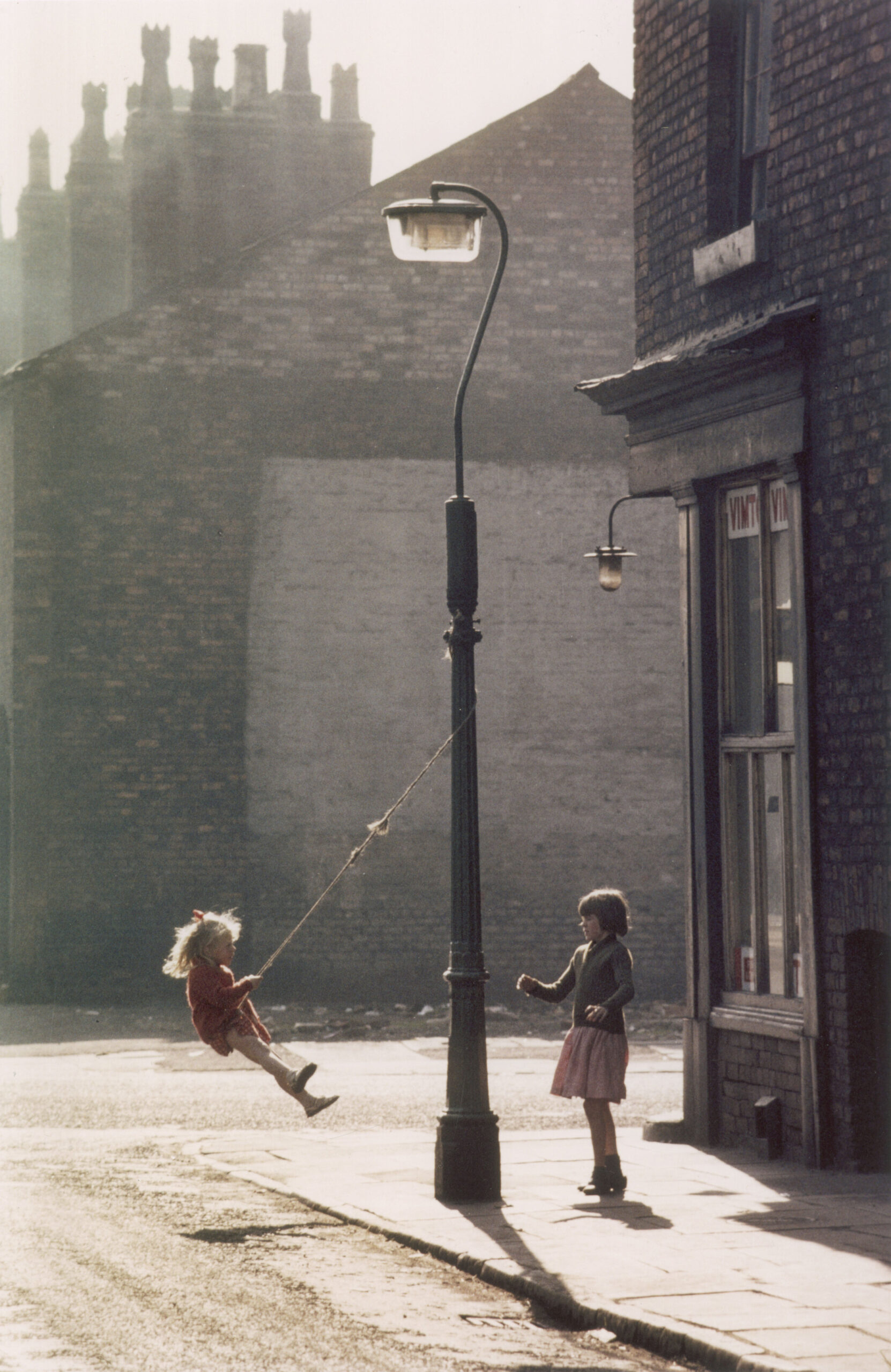
Shirley
Baker.
The Rolleiflex round her neck, Salford and Manchester being demolished around her — and one of post-war Britain's great social documents being quietly built.
Born
Kersal, North Salford · 1932
Streetwork
1961 – 1981 · Salford & Manchester
Collected by
Tate · Manchester Art Gallery · The Photographers' Gallery
One of the very few women in post-war Britain to be given formal photographic training.
Shirley Baker (1932–2014) was born in Kersal, North Salford. She studied Pure Photography at Manchester College of Technology, with further training at Regent Street Polytechnic and the London College of Printing, and — at sixty — completed an MA in Critical History and Theory of Photography at the University of Derby.
Between 1961 and 1981 Shirley turned her Rolleiflex on the working-class inner-city streets of Salford and Manchester as they were torn apart by the slum-clearance programmes. Working unposed and on the move, she produced an empathetic, often wryly humorous body of work in both black-and-white and — remarkably for the period — pioneering Kodachrome colour.
Her subjects were the women, children and loitering men whose communities the planners forgot: kids swinging from lampposts, mothers chatting over an ice-cream van, washing strung across the rubble. In the 1980s she also photographed punks in and around Camden Lock, the interiors of the Royal Manchester Children's Hospital and the daily rhythms of Manchester Airport.
Her work has been published by Bloodaxe, The Lowry, The Photographers' Gallery, MACK, Hoxton Mini Press and Café Royal, and exhibited at The Photographers' Gallery (2015 — one of their most highly-attended shows), Manchester Art Gallery, Tate Britain (Fear and Freedom, 2025–), the Barbican (Postwar Modern, 2022) and the Sainsbury Centre. Her photographs are now held in major public collections in the UK.
"I love the immediacy of unposed, spontaneous photographs and the ability of the camera to capture the serious, the funny, the sublime and the ridiculous."
The streets
Salford & Manchester
Twenty years on the same pavements as the bulldozers — recording the neighbourhoods that the planners erased.
The colour
Pioneering Kodachrome
She used colour film in the 1960s when serious British photographers refused to. These pictures look more contemporary every year.
The legacy
A late rediscovery
The 2015 Photographers' Gallery show — one of their most-visited ever — put her where she always belonged: alongside the great post-war British documentarians.
Forty years of recognition — quiet at first, then everywhere.
Shirley worked for two decades on the streets of Salford and Manchester before her first major book; another two before the major institutional shows. Selected milestones below.
- 1989
Street Photographs · Bloodaxe Books
Her first major monograph — the Salford and Manchester pictures she'd quietly been making since the early '60s, finally published in book form.
- 2000
Streets and Spaces · The Lowry, Salford
The Lowry mounts her first major institutional retrospective, reuniting her colour and black-and-white work for a Salford audience that recognised every street.
- 2015
Women, Children and Loitering Men · The Photographers’ Gallery, London
One of the most highly-attended shows in The Photographers’ Gallery’s history. The single moment that put Baker back in the national conversation about post-war British photography.
- 2019
Shirley Baker · MACK Books
MACK’s definitive monograph collects the colour and B&W work alongside Anna Douglas’s essay — now the standard reference on Baker.
- 2022
Postwar Modern: New Art in Britain 1945–65 · Barbican Art Gallery
Baker shown alongside Bacon, Bomberg, Auerbach and Hepworth in the Barbican’s major postwar British survey — quiet vindication of where her work belongs.
- 2024
Hoxton Mini Press · Manchester Streets Pocket Edition
A pocket-edition reissue of the Manchester pictures — the kind of cult, hand-sold photo-book that introduces a whole new generation of readers to Baker.
- 2025–
Fear and Freedom: British Photography 1945–1989 · Tate Britain
Tate Britain hangs Baker in a major British photography survey, the canonical institutional confirmation.
- 2026
Shirley Baker · Zebra One Gallery, Hampstead
A summer exhibition of estate-authorised prints, with an evening hosted by Nan Levy — Shirley’s daughter and keeper of the archive — marking what would have been Baker’s 94th birthday.
An evening with Nan Levy.
Join us at the gallery for an intimate evening with Nan Levy — Shirley’s daughter and keeper of her archive — marking what would have been Shirley’s 94th birthday with the opening preview of our summer exhibition and an exclusive print run.
- Date Thursday, 25 June 2026
- Time 6:00 pm – 8:00 pm
- Location Zebra One Gallery · 1 Perrins Court, Hampstead NW3
- RSVP info@zebraonegallery.com
24 photographs, one extraordinary archive.
Every Shirley Baker print held at Zebra One Gallery, grouped into the bodies of work she returned to throughout her life. Click any photograph to see edition details and price.
1965 · Colour
Shirley shot Kodachrome at a time when serious British photographers wouldn't touch colour. These pictures — children swinging from lampposts, mothers gathered around an ice-cream van — are now her most reproduced and the cornerstone of her recent reappraisal.
1960s · B&W
The body of work she's most celebrated for. Between 1961 and 1981 Shirley walked the streets of Salford and Manchester with a Rolleiflex round her neck as whole neighbourhoods were demolished around her — and quietly built one of the great social documents of post-war Britain.
1960s · Mixed
Further pictures from the same decade — found moments, the wry humour Shirley was known for, the ordinary lives the planners forgot.
Punks · 1980s
By the early '80s Shirley was photographing punks in and around Camden Lock — the same unposed, eye-level register she'd taken to Salford, brought to a new subculture growing on a London street.
Dogs
Dogs ran through Shirley's work the whole way through — a coalman and his dog, the local dog show, strays trotting past the rubble. She loved them, and her dog pictures carry a comic, slightly mournful warmth that runs counter to the more serious frames.
Blackpool
When Shirley wasn't on the streets of Manchester she was at Blackpool — balloon men, smoking mums, dudes asleep on the sand. Pictures full of warmth, sunburn and quiet British holiday absurdity.
South of France
Her Mediterranean counterpoint — Côte d'Azur sun-worshippers and couples on the sand, shot with the same unposed, sideways eye she brought to Manchester.
Enquire about a Shirley Baker print.
All works are estate-authorised prints, available framed or unframed. Pricing is on request — get in touch with Gabrielle and the gallery team to discuss availability, framing options and shipping.
Zebra One Gallery is an authorised dealer of the Estate of Shirley Baker.